
Across Germany and Europe, regulatory mandates have permanently altered the feedstock economics of anaerobic digestion (AD). Under the German Renewable Energy Sources Act (EEG 2023 § 39h), the Maisdeckel (maize cap) restricts maize silage and cereal grain input to 30% mass weight by 2026 for fermented biomass. Simultaneously, the EU Renewable Energy Directive (RED III, Annex IX) heavily incentivizes biomethane with low Carbon Intensity (CI) scores derived from livestock manure (Gülle and Festmist) and agricultural residues like straw.
While policymakers view this as a simple feedstock substitution, process engineers on the ground face a harsh biological reality: Germany’s fleet of ~9,000 biogas plants was predominantly built to digest α-glycosidic starch bonds, not β-1,4-glycosidic lignocellulosic matrices.
When an existing mesophilic (38–42°C) Continuously Stirred Tank Reactor (CSTR) transitions from Maissilage to straw-heavy manure or agricultural by-products without altering its front-end process configuration, the plant experiences a severe collapse in Volatile Solids (VS / oTS) destruction.
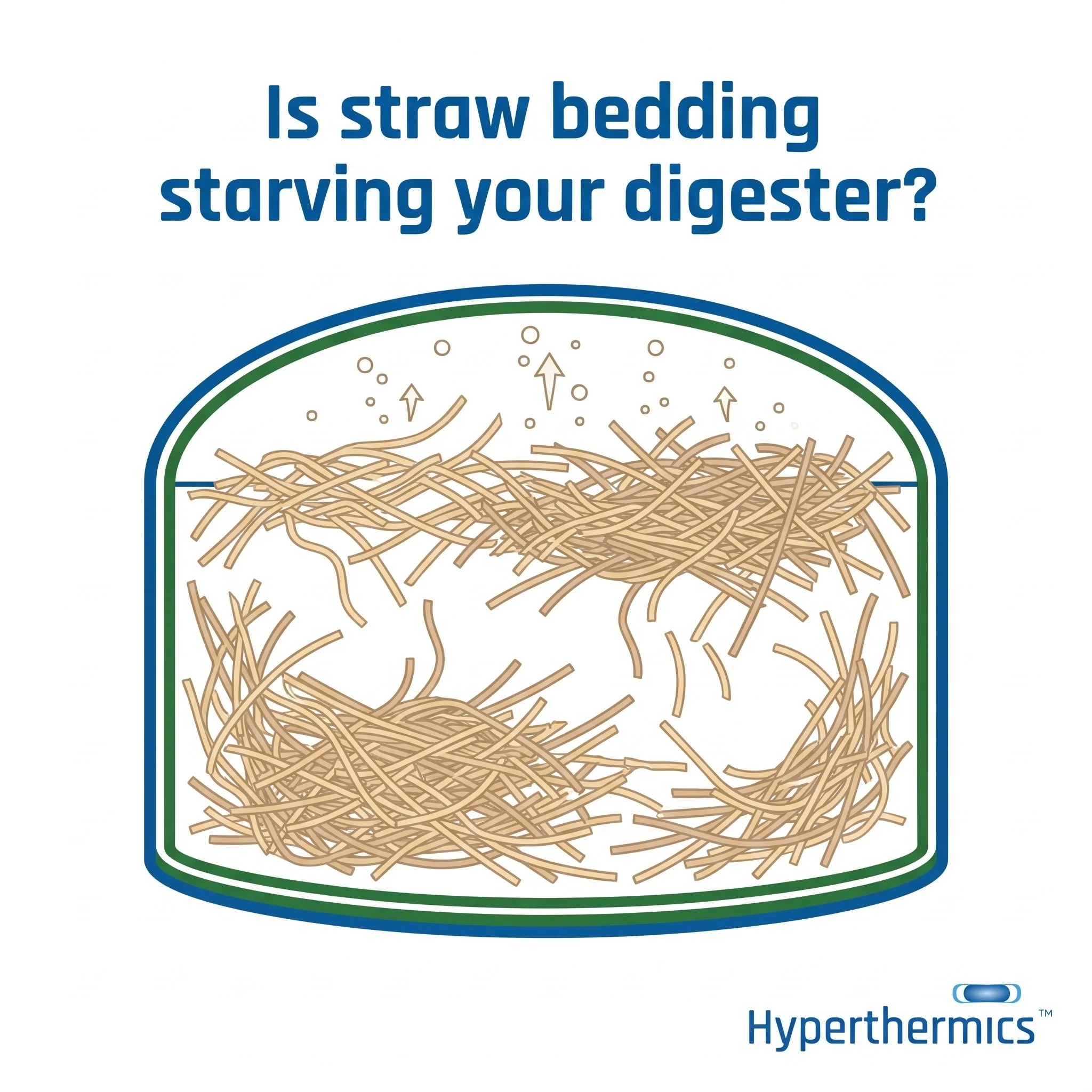
The Kinetic Bottleneck: Starch vs. Lignocellulose
In anaerobic digestion of particulate organic matter, hydrolysis is the rate-limiting step, typically modeled via first-order kinetics:
dX/dt = -k_h · X
Where X is the concentration of degradable particulate substrate and k_h is the first-order hydrolysis rate constant (d⁻¹).
According to standard German agricultural benchmarks (KTBL-Datensammlung Biogas) and ADM1 modeling parameters established by Weinrich & Nelles (2021):
Maize Silage (Maissilage): Rich in non-structural carbohydrates (starch) and lactic acid. It exhibits a high carbohydrate hydrolysis constant (k_ch ≈ 0.4 to 0.8 d⁻¹) and achieves 80–85% VS degradation within a standard 50-to-70-day Hydraulic Retention Time (HRT).
Lignocellulosic Residues (Cattle Manure with Straw, Rinderfestmist, Cereal Straw): Composed of crystalline cellulose, hemicellulose (xylan), and Acid Detergent Lignin (ADL). Lignin forms a hydrophobic physical barrier that blocks mesophilic exo-enzymes (cellulases and xylanases) from accessing the carbohydrate polymers. Consequently, the effective k_h drops to 0.05–0.15 d⁻¹, and overall VS degradation in a standard CSTR falls to 45–55% (Mönch-Tegeder et al., 2013; MDPI Methane, 2026).
In practical mass-balance terms: when an operator replaces maize with fibrous Wirtschaftsdünger, nearly half of the incoming organic carbon passes straight through the primary fermenter unfermented.
Three Operational Penalties for Retrofit Plants
For an existing German biogas plant—whether operating under EEG Flexibilisierung or repowering into a biomethane upgrading facility—this drop in VS destruction triggers three compounding penalties:
Specific Methane Yield (SMY) Deficit & Stranded Volume: Because the insoluble fibers occupy reactor volume without rapidly converting to dissolved Chemical Oxygen Demand (COD_s), the effective Organic Loading Rate (OLR, measured in kg VS·m⁻³·d⁻¹) must be throttled back to prevent washout or excessive solids accumulation.
Slurry Rheology and Parasitic Power Draw: Research at the Deutsches Biomasseforschungszentrum (DBFZ) demonstrates that unhydrolyzed long-chain fibers drastically increase the fluid consistency factor (K) of digester slurry (DBFZ Rheology Study, 2020). This drives up electricity consumption for submersible agitators, blinds decanter centrifuges during digestate dewatering, and causes severe floating layers (Schwimmschichten).
Residual Methane Potential (Restgaspotenzial) under TA Luft / BImSchG: Because hydrolysis is so slow at 40°C, fiber degradation continues after the substrate leaves the main fermenter and enters the digestate storage tank (Gärrestlager). Under tightened German TA Luft and BImSchG regulations, operators face strict limits on residual gas potential and mandatory gas-tight storage covers. Leaving 45% of your volatile solids unfermented shifts gas production out of the revenue-generating fermenter and into the storage lagoon.
Why "More Concrete" or Commercial Enzymes Fall Short
Historically, EPCs have tried to compensate for slow k_h values by increasing HRT—building additional concrete post-digesters (Nachgärer)—or installing high-maintenance mechanical macerators and steam-explosion units.
However, building new concrete tanks in Germany today is CAPEX-prohibitive, slow to permit under BImSchG, and thermodynamically inefficient (heating and mixing massive volumes of water just to wait for slow mesophilic biology). Similarly, full-scale trials at DBFZ have shown that simply dosing commercial fungal enzymes directly into a mesophilic CSTR often reduces slurry viscosity slightly without delivering a statistically significant increase in specific biomethane yield (DBFZ, 2020), because the temperature and pH in a single-stage CSTR are suboptimal for aggressive lignocellulosic cleavage.
The Hyperthermophilic Retrofit: Decoupling Hydrolysis at 80°C
To process post-maize feedstocks inside existing CSTR footprints, hydrolysis must be physically and thermodynamically decoupled from methanogenesis.
According to the Arrhenius equation, chemical and enzymatic reaction rates roughly double for every 10°C increase in temperature—provided the biocatalysts remain thermally stable. While standard thermophilic AD operates at 50–55°C, true hyperthermophilic bacteria (originally isolated from deep-sea hydrothermal vents) thrive at 80°C.
At Hyperthermics, we have engineered this biology into a compact, bolt-on Biogas Booster designed specifically for brownfield CSTR retrofits:
Accelerated First-Order Kinetics (k_h): Operating at 80°C at atmospheric pressure with an HRT of just 16 to 24 hours, the hyperthermophilic consortium produces extreme-heat hydrolases (thermostable cellulases, xylanases, and proteases). The combined thermal and biological energy swells the lignocellulosic matrix, strips hemicellulose, and rapidly solubilizes particulate organics into Volatile Fatty Acids (VFAs), predominantly acetate.
Drop-in CSTR Repowering: Because the Biogas Booster acts as an upstream biological pre-treatment reactor, it feeds your existing mesophilic or thermophilic CSTR with pre-hydrolyzed, low-viscosity, VFA-rich substrate. Your existing methanogens no longer wait on rate-limiting fiber hydrolysis—they immediately convert dissolved acetate and H₂/CO₂ into methane.
Built-In EU 1069/2009 Hygienization: For plants taking in Category 2/3 manure, poultry litter (Hühnertrockenkot), or biowaste that already require thermal pasteurization at ≥ 70°C for 1 hour, elevating that thermal step to an active 80°C biological reactor turns a dead-weight regulatory energy sink into a gas-yield multiplier.
Exploring Pilot & Retrofit Cases in Germany
Transitioning away from Maissilage does not have to mean accepting a 30% drop in plant output or spending millions on new concrete digester volume. By solving the hydrolysis bottleneck at 80°C at the front end, existing plants can unlock the dormant volatile solids trapped in straw, solid manure, and agricultural residues.
We are currently looking to connect with German biogas operators, biomethane developers, and agricultural engineering partners who are navigating the post-maize transition or planning plant repowering (Flexibilisierung or biomethane upgrading).
If you are seeing higher digestate dry matter, rising agitator power consumption, or lower specific gas yields as you increase your Wirtschaftsdünger and straw fractions, contact our engineering team to evaluate your current substrate mass balance and explore how a hyperthermophilic retrofit performs on your specific feedstock mix.
References & Further Reading
EEG 2023 (§ 39h): Gesetz für den Ausbau erneuerbarer Energien – Maisdeckel reduction to 30% in 2026. gesetze-im-internet.de
RED III (Directive EU 2023/2413): Annex IX feedstocks and GHG Carbon Intensity accounting for advanced biomethane. EUR-Lex
Weinrich, S., & Nelles, M. (2021): Systematic simplification of the Anaerobic Digestion Model No. 1 (ADM1) – First-order hydrolysis constants (k_ch, k_pr, k_li) for agricultural substrates. Bioresource Technology. DOI: 10.1016/j.biortech.2021.125085
Mönch-Tegeder, M., Lemmer, A., Oechsner, H. (2013): Investigation of the methane potential of horse manure and straw bedding fractions (ADL and XF limitations). CIGR Journal. Link to Paper
DBFZ (2020): Influence of Enzyme Additives on the Rheological Properties of Digester Slurry and on Biomethane Yield in Full-Scale CSTRs. Deutsches Biomasseforschungszentrum. ResearchGate Link
MDPI Methane (2026): Simulation-Based Assessment of Pretreatment-Assisted Anaerobic Co-Digestion of Wheat Straw and Cattle Manure. Link to Study