

Beyond the Thauer Limit: Why 80°C Hyperthermophilic Fermentation Changes the Economics of Biohydrogen
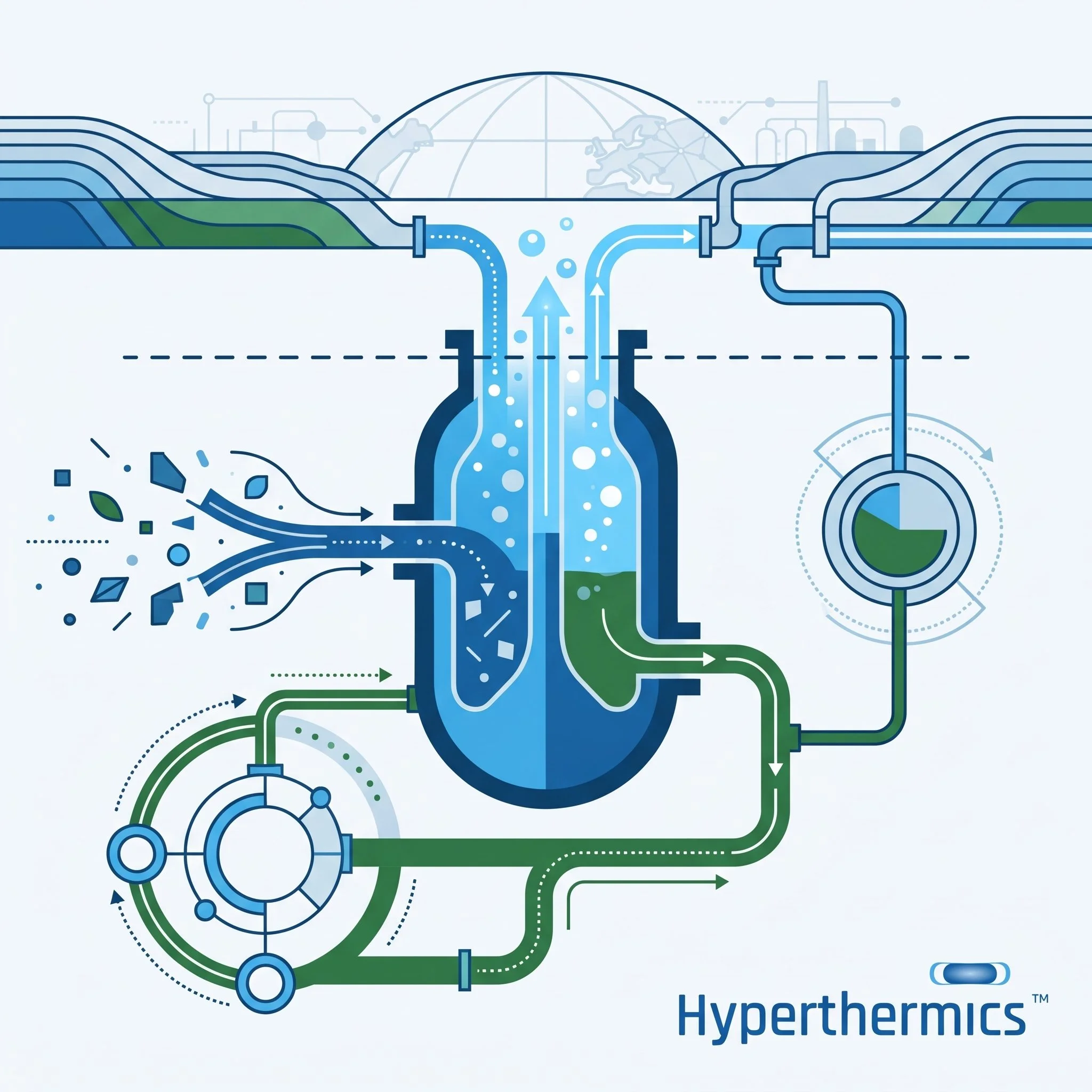
Biological hydrogen production via dark fermentation has long stalled between laboratory promise and industrial deployment. While converting wet organic waste into hydrogen without light input is chemically straightforward, conventional mesophilic systems (35–40°C) suffer from low volumetric productivity, microbial contamination, and an unfavorable carbon balance [1].
At Hyperthermics, operating continuous fermentation at 80°C with hyperthermophilic bacteria such as Thermotoga shifts both the reaction kinetics and the thermodynamic constraints of dark fermentation [2].
1. The Stoichiometric Ceiling and the Partial Pressure Trap
Complete biological oxidation of glucose to hydrogen and carbon dioxide (C₆H₁₂O₆ + 6 H₂O → 12 H₂ + 6 CO₂) is endergonic under standard physiological conditions (ΔG°' = +3.2 kJ · mol⁻¹) and does not occur in nature. In dark fermentation, bacteria conserve energy by coupling hydrogen evolution to partial oxidation of carbohydrates into volatile fatty acids (VFAs).
As established by Thauer et al. (1977), the practical thermodynamic ceiling is 4 moles of H₂ per mole of hexose when acetate is the sole soluble end-product:
C₆H₁₂O₆ + 2 H₂O → 2 CH₃COO⁻ + 2 H⁺ + 4 H₂ + 2 CO₂ (ΔG°' = −206 kJ · mol⁻¹)
In practice, mesophilic dark fermentation rarely approaches this 4 mol · mol⁻¹ ceiling, typically yielding 1.5 to 2.5 mol H₂ per mol hexose [1]. Two mechanisms drive this loss:
Dissolved H₂ Partial Pressure (pH₂) Inhibition: Hydrogenases—particularly those coupled to NADH oxidation—are thermodynamically sensitive to product accumulation. Once dissolved pH₂ exceeds roughly 60 Pa, forward electron transfer to protons stalls. Microorganisms re-route excess reducing equivalents into butyrate, lactate, or ethanol, cutting hydrogen stoichiometry in half [1].
In-Situ H₂ Consumption: Real-world industrial and agricultural feedstocks carry indigenous microflora. Without continuous sterilization, hydrogenotrophic methanogens and homoacetogens rapidly colonize mesophilic reactors, consuming the evolved H₂ to form CH₄ or acetate before it ever reaches the headspace [1].
2. What Changes at 80°C
Moving the operating temperature from 37°C to 80°C alters the physical chemistry and microbiology of the reactor simultaneously:
Reduced Gas Solubility and Improved Thermodynamics: At 80°C, the aqueous solubility of H₂ drops significantly compared to mesophilic temperatures, accelerating mass transfer from the liquid phase into the headspace and relieving product inhibition on hydrogenase enzymes. Furthermore, elevated temperature shifts the Gibbs free energy (ΔG) of proton reduction in favor of H₂ formation.
Thermal Selection Without Sterilization OPEX: Continuous operation at 80°C exceeds the thermal survival threshold of methanogens and mesophilic homoacetogens. The reactor maintains a stable, H₂-producing hyperthermophilic culture—such as Thermotoga neapolitana—on non-sterile waste streams without steam-sterilization CAPEX or chemical inhibitors [2].
Accelerated Hydrolysis and Conversion Rates: Hyperthermophilic enzymes hydrolyze complex polymeric substrates at rates orders of magnitude faster than mesophilic consortia, compressing hydraulic retention times from days to hours [2].
3. Solving the 67% Carbon Balance Problem
Even at the theoretical Thauer limit of 4 mol H₂ per mol glucose, two-thirds (67%) of the original feedstock carbon remains in the liquid phase as acetate (2 CH₃COO⁻). Any process designed solely around gas collection leaves the majority of the substrate’s chemical energy unmonetized while generating a high-COD effluent that requires costly wastewater treatment.
Hyperthermics’ 80°C reactor architecture is built to capture both outputs as distinct, uncontaminated product streams:
Gas Phase (H₂ / CO₂): A clean, sulfur-reduced biohydrogen stream stripped rapidly from the hot broth, ready for gas upgrading or direct industrial use.
Liquid Phase (Sterile Bioacetate): A hygienized, soluble organic carbon stream free of competing pathogens and particulate solids.
Rather than treating bioacetate as a waste by-product, it serves as a high-grade carbon feedstock for secondary bioprocesses—including mixotrophic and heterotrophic microalgae cultivation (where acetate bypasses photosynthetic light limitations and accelerates CO₂ fixation), oleaginous yeast fermentation for microbial lipids, or downstream biomethane polishing.
4. Ongoing Development and R&D Partnerships
Scaling continuous hyperthermophilic dark fermentation requires balancing dilution rates, organic loading, and dissolved gas stripping to prevent by-product inhibition and maintain high cell viability [2].
Hyperthermics is actively collaborating with industrial biorefinery operators, process engineers, and academic R&D groups to test continuous 80°C Thermotoga fermentation on regional waste streams and integrate bioacetate output into downstream CCU, single-cell protein, and precision fermentation cascades.
If your team is working on continuous dark fermentation, gas-stripping reactor designs, or acetate-fed bioprocesses, reach out to our engineering team to discuss pilot testing and mass-balance modeling.
References
Thauer, R. K., Jungermann, K., & Decker, K. (1977). Energy conservation in chemotrophic anaerobic bacteria. Bacteriological Reviews, 41(1), 100–180.
A Review on Biohydrogen Production Through Dark Fermentation, Process Parameters and Simulation. (2025). Energies, MDPI. [1]
Moll, F., Hansen, L., Tix, J., & Tippkötter, N. (2025). Enhanced Biohydrogen Production Through Continuous Fermentation of Thermotoga neapolitana: Addressing By-Product Inhibition and Cell Viability in Different Bioreactor Mo